The Commander
Who this is for: anyone who knows the basics (see Magic Basics) and wants the rules that make Commander its own format. By the end you’ll understand what can be a commander, the command zone, the commander tax, the command-zone replacement effect, color identity, why “wish” effects don’t work, and how companions fit in. This is the mechanical heart of the format.
🆕 New players: this is the densest chapter in the guide. Take the sections one at a time — each is short. 🔁 Returning players: even if you played base Magic recently, almost everything here is Commander-only. One rule (which legendary cards can be a commander) changed recently — flagged below. 🎯 Commander-specific: all of it. This chapter is the format’s rules core.
What can be a commander
Section titled “What can be a commander”Your commander must be a legendary card. Per the 2026 Comprehensive Rules (§903.3), the eligible card must be one of:
- a legendary creature card (the classic, by far most common choice),
- a legendary Vehicle card, or
- a legendary Spacecraft card with one or more power/toughness boxes.
You choose it before the game, and it’s the card your whole deck is built around.
🔁 Returning players: here’s a recent change — for most of the format’s history, commanders were legendary creatures only. The pool was widened to include legendary Vehicles and Spacecraft (those with a power/toughness box), introduced alongside the Edge of Eternities set. If you stopped playing before then, this is genuinely new — a Vehicle in the command zone used to be impossible. (This is now confirmed directly against Comprehensive Rules §903.3, effective 2026-02-27 — see SOURCES.md fact #7.)
🆕 New players: for your first deck, just pick a legendary creature you think is cool. That’s the well-trodden path, and the Vehicle/Spacecraft options are a niche you can explore later.
The command zone
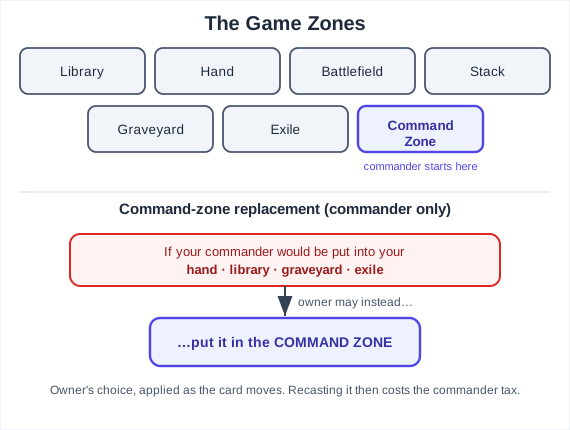
Section titled “The command zone”Your commander doesn’t start in your deck or your hand. It starts face-up in the command zone — a special zone that exists alongside the familiar ones (library, hand, battlefield, graveyard, exile; see Magic Basics).
From the command zone you can cast your commander as a spell, like casting it from your hand — paying its mana cost (plus the tax, below). This is why your commander is reliably available: it’s not buried in a 100-card library; it’s waiting for you.
Commander tax
Section titled “Commander tax”Casting your commander from the command zone gets more expensive each time. The commander tax adds {2} generic mana for each previous time you’ve cast it from the command zone this game.
- First cast from the command zone: normal mana cost.
- Second cast: normal cost + {2}.
- Third cast: normal cost + {4}, and so on.
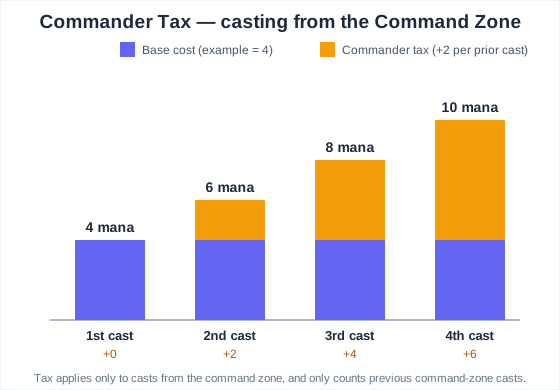
The tax only applies to casts from the command zone. If your commander ends up in your hand or graveyard and you cast it from there, no tax is added (though that’s usually rarer than recasting from the command zone).
🆕 New players: the tax is why letting your commander die over and over eventually prices it out of your turn. Each return trip through the command zone costs {2} more.
🎯 Commander-specific: the tax exists to keep an indestructible-feeling commander from being recast infinitely for free. It’s the format’s built-in brake on commander recursion.
The command-zone replacement effect
Section titled “The command-zone replacement effect”Here’s the rule that keeps your commander from getting lost. Whenever your commander would be put into your hand, library, graveyard, or exile — from anywhere, for any reason — its owner may instead move it to the command zone.
It’s the owner’s choice, made as the card moves. Choose the command zone and your commander is immediately available to cast again (subject to the tax); decline and it goes where it was headed.
🆕 New players: this means an opponent destroying your commander rarely gets rid of it for long — you just send it back to the command zone and recast it later. The cost you pay is the escalating tax, not the loss of the card.
🔁 Returning players: this is a replacement effect, applied as the card moves, not a triggered ability you put on the stack — so it doesn’t get a response window of its own.
Color identity
Section titled “Color identity”Color identity is the rule that bounds your entire deck. A card’s color identity is:
- its color(s), plus
- the colors of any colored mana symbols appearing in its mana cost and in its rules text.
This is determined before the game and is fixed. Every card in your deck must have a color identity that fits inside your commander’s color identity. A green-white commander, for example, can’t include a card that has a blue mana symbol anywhere in its cost or text — that card’s identity includes blue, which is outside the commander’s.
🆕 New players: color identity is stricter than “what colors is this card.” A card with no colored cost can still be, say, red by identity because of a red symbol in its rules text. Check the whole card, not just the top corner.
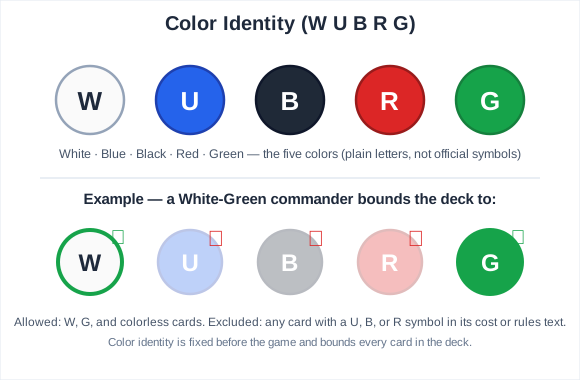
🎯 Commander-specific: color identity is what makes your commander a genuine deckbuilding constraint, not just a strong card. We put it to practical use in Deckbuilding.
”Outside the game” effects don’t function
Section titled “”Outside the game” effects don’t function”Some cards reach for cards outside the game — “wish” effects that fetch a card you own from your sideboard or collection (the classic Wish-style cards, and similar abilities). In Commander, the parts of those abilities that bring other cards in from outside the game simply don’t function. There’s no sideboard to wish from, so those effects do nothing.
🆕 New players: you can still run such a card if it does other things, but the “go get a card from outside” part won’t work at a Commander table.
🔁 Returning players: the precise 2026 rule (CR §903.11a) is slightly narrower than “wishes never work”: if some effect does legally bring a card in from outside the game, that card still can’t share a name with anything in your starting deck and must fit your commander’s color identity. In ordinary play there’s no sideboard or card pool to fetch from, so the practical answer remains “they do nothing” — unless your group agrees to allow a card pool via Rule 0.
Companions
Section titled “Companions”A companion is a card that can sit outside your deck and be brought into the game if you met its special deckbuilding condition. In Commander:
- a companion must obey your commander’s color identity, and
- it must obey singleton like everything else.
It isn’t part of your 100-card deck, but it functions as an effective 101st card you may have access to.
🆕 New players: companions are an advanced, optional wrinkle. You can ignore them entirely for your first decks.
🎯 Commander-specific: note the asymmetry — a companion must fit your commander’s color identity, but a companion does not add to it. Only your commander defines your color identity.
Quick recap
Section titled “Quick recap”- Commander = a legendary card: a creature, a Vehicle, or a Spacecraft (with a power/toughness box) — per Comprehensive Rules §903.3.
- It starts in the command zone and can be cast from there.
- Commander tax: +{2} per previous cast from the command zone.
- Command-zone replacement: heading to hand/library/graveyard/exile? Owner may send it to the command zone instead.
- Color identity (colors + all colored symbols in cost and text) is fixed pre-game and bounds the whole deck.
- Wish / “outside the game” effects don’t function.
- A companion must obey color identity + singleton; it’s effectively a 101st card.
What to read next
Section titled “What to read next”- Putting color identity and singleton to work → Deckbuilding
- How commander damage ends games → Combat and Winning and Losing
- Any unfamiliar term → Glossary
Sources: commander eligibility (§903.3), command zone (§903.6), commander tax (§903.8), command-zone replacement (§903.9a/b), color identity (§903.4), “outside the game” effects (§903.11), plus the companion color-identity/singleton rule, all paraphrase the Magic Comprehensive Rules §903 effective 2026-02-27 (SOURCES.md S1) — verified directly against the primary text — corroborated for companion specifics by the official Commander rules (S3). Facts #1, #2, #4, #7, #8, #9. No rules text is quoted at length.