Anatomy of a Turn
Who this is for: players who know what cards and mana are (see Magic Basics) and now want to understand the order things happen in. By the end you’ll be able to narrate a turn out loud, know when you’re allowed to act, and understand how instants and abilities interrupt the flow via the stack.
🆕 New players: the single most common beginner mistake is doing things in the wrong order (attacking before playing a land, casting a sorcery on someone else’s turn). This chapter fixes that. 🔁 Returning players: the phase structure is unchanged, but it’s worth re-grounding the stack and priority vocabulary, which is how every interaction is described today. 🎯 Commander-specific: turn structure is identical in Commander. What changes is that you take your turn in a multiplayer circle, and any opponent’s instant-speed response could come from three directions, not one.
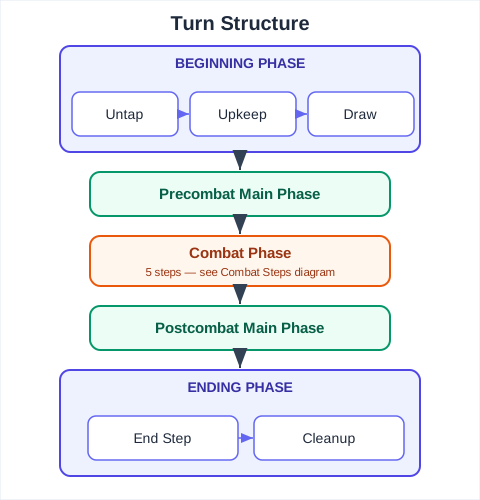
The five phases, in order
Section titled “The five phases, in order”A turn always runs through the same phases in the same order. Some phases contain multiple steps. Here’s the whole skeleton, then we’ll walk it:
- Beginning phase — Untap step → Upkeep step → Draw step
- First main phase (your “precombat” main)
- Combat phase — five steps (overview below; details in Combat)
- Second main phase (your “postcombat” main)
- Ending phase — End step → Cleanup step
1. Beginning phase
Section titled “1. Beginning phase”- Untap step: you untap your tapped permanents — your lands and creatures stand back up, ready to use. Nobody gets to act here.
- Upkeep step: a window right after untapping. Many cards say “at the beginning of your upkeep…”; those trigger now. Players can respond.
- Draw step: you draw a card from your library.
🆕 New players: the very first player of the game skips their first draw step in most formats, so they don’t get a turn-one card advantage.
🎯 Commander-specific: that “skip the first draw” rule still applies in multiplayer Commander — only the very first turn of the game, for the starting player.
2. First main phase
Section titled “2. First main phase”Your main “do stuff” window. Here you can:
- play your one land for the turn (lands don’t use the stack),
- cast sorceries, creatures, artifacts, enchantments, and planeswalkers (collectively, “sorcery-speed” things),
- cast instants and activate abilities (you can do those almost anytime, but this is a calm moment to do them).
🆕 New players: a useful default is to play your land first every turn, so you never forget it and never short yourself on mana.
🎯 Commander-specific: many players cast their commander from the command zone during a main phase like any other creature — including paying the escalating commander tax. See The Commander.
3. Combat phase
Section titled “3. Combat phase”Combat is its own phase with five steps. Here’s just the overview — the real detail (attacking, blocking, damage, and commander damage) lives in Combat:
- Beginning of combat
- Declare attackers
- Declare blockers
- Combat damage
- End of combat
🆕 New players: you choose whether to attack at all. Skipping combat is a perfectly normal turn.
4. Second main phase
Section titled “4. Second main phase”Identical permissions to the first main phase. It exists so you can react to how combat went — e.g. hold up a creature as a potential blocker during combat, then deploy your remaining mana after you see the results.
5. Ending phase
Section titled “5. Ending phase”- End step: a final window where “at the beginning of the end step…” effects trigger and players can cast instants.
- Cleanup step: if you have more than seven cards in hand, you discard down to seven. Damage marked on creatures wears off. Normally nobody acts here.
🔁 Returning players: the discard-to-seven and damage-wears-off cleanup behavior is unchanged. Worth remembering that “until end of turn” effects end here, in cleanup.
The stack: how spells and abilities actually happen
Section titled “The stack: how spells and abilities actually happen”Magic almost never resolves things instantly. Instead, spells and activated/ triggered abilities go onto the stack and wait. The stack works last in, first out — like a stack of plates, the last thing added is the first thing resolved.
flowchart TD
    A([Active player receives priority]) --> B{Do something?}
    B -->|Cast a spell or activate an ability| C[Add it to the TOP of the stack]
    C --> A
    B -->|Pass| D[Priority passes to the next player in turn order]
    D --> E{Has everyone passed in succession?}
    E -->|No| A
    E -->|Yes, and the stack is empty| F([Step / phase ends])
    E -->|Yes, but the stack is NOT empty| G[Resolve the TOP item of the stack<br/>LIFO: last in, first out]
    G --> A
Diagram source: diagrams/stack-priority.mmd.
A small worked example:
- You cast a creature spell. It goes on the stack.
- An opponent responds with an instant that would destroy it. Their instant goes on top.
- Nobody adds anything else. The stack resolves from the top: the instant resolves first, then your creature spell tries to resolve.
That “last added resolves first” ordering is why responding works: a fast answer cast in response happens before the thing it’s answering.
🆕 New players: lands are the exception — playing a land doesn’t use the stack and can’t be responded to. Everything else (spells and most abilities) does use it.
Priority: when you’re allowed to act
Section titled “Priority: when you’re allowed to act”Priority is the right to take an action. The rule of thumb:
- The active player (whose turn it is) gets priority first in each step.
- After someone acts (or passes), priority passes around the table.
- When all players pass with the stack empty, the current step or phase ends.
- When all players pass with something on the stack, the top object resolves — then priority resets to the active player.
So a phase doesn’t end until everyone has agreed there’s nothing left to do. Instants and most activated abilities can be used almost any time you have priority — including during an opponent’s turn — which is what makes them reactive. Sorceries, creatures, and other sorcery-speed cards can only be cast when you have priority during your own main phase with an empty stack.
🆕 New players: “I’d like to respond” is always a legal thing to say when you have priority. If you have nothing to do, you pass — and play continues.
🔁 Returning players: nothing structural has changed about priority, but modern rules language leans on it heavily. If you learned the game informally, internalizing “priority passes; all-pass resolves the top of the stack” makes every interaction unambiguous.
🎯 Commander-specific: in a multiplayer game, priority passes in turn order around the whole table. After the active player passes, the player to their left is next, and so on. That means an attack or a big spell can draw instant-speed responses from several opponents in sequence — politics and timing matter (see Multiplayer & Politics).
Quick recap
Section titled “Quick recap”- Phases always run: beginning → main 1 → combat → main 2 → ending.
- One land per turn; sorcery-speed things only in your main phases with an empty stack; instants almost anytime.
- The stack resolves last-in-first-out, which is why responses work.
- A step ends only when everyone passes priority.
What to read next
Section titled “What to read next”- The combat phase in full → Combat
- Casting your commander and the command zone → The Commander
- Any unfamiliar term → Glossary
Sources: turn structure, the stack, and priority paraphrase the Magic Comprehensive Rules (SOURCES.md S1). Commander-specific notes on multiplayer turn order trace to the official Commander format rules (SOURCES.md S2). No rules text is quoted at length.