Combat
Who this is for: players who understand the turn’s phases (see Anatomy of a Turn) and want to know how attacking and blocking actually resolve. By the end you’ll know the five combat steps, how to attack across multiple opponents, the handful of keywords that change combat math, and the Commander-only rule that 21 combat damage from one commander eliminates a player.
🆕 New players: combat is where most games are won. Take it slow the first few times — there’s a fixed order, and once you know it, it’s very mechanical. 🔁 Returning players: the step order and core keywords are the same as you remember. The big addition for you is multiplayer attacking and commander damage. 🎯 Commander-specific: combat is the format’s main path to victory, and the 21-damage commander rule gives every game a second, parallel “clock.” Both are covered below.
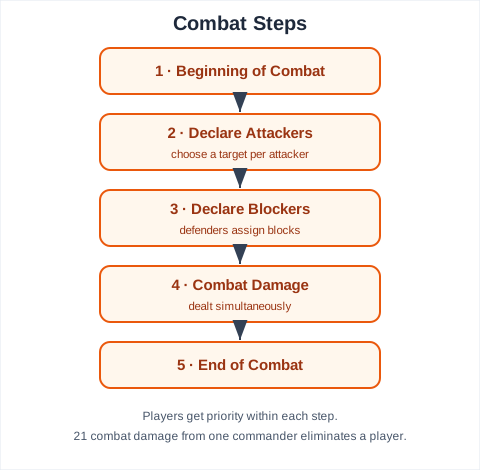
The five combat steps
Section titled “The five combat steps”Combat is one phase made of five steps, always in this order:
- Beginning of combat: a window before attackers are declared. “At the beginning of combat…” triggers happen; players can cast instants (e.g. to tap down a potential attacker).
- Declare attackers: the active player chooses which of their untapped creatures attack, and what each one attacks (more on targets below). Attacking usually taps the creature.
- Declare blockers: each defending player chooses how their untapped creatures block the incoming attackers. One blocker can stop one attacker; multiple blockers can gang up on one attacker.
- Combat damage: attackers and blockers deal damage simultaneously, equal to their power. Unblocked attackers hit what they were attacking.
- End of combat: a final combat window before the phase ends.
🆕 New players: an unblocked creature deals its damage to whatever it was attacking. A blocked creature deals its damage to the blocker(s) instead — even if the blocker dies, the attacker usually doesn’t “get through” unless it has trample (see below).
Attacking and blocking, concretely
Section titled “Attacking and blocking, concretely”- You can only attack with creatures you control that are untapped and have been under your control since your turn began (the “summoning sickness” rule — a creature can’t attack the turn it arrives unless it has haste).
- The defender decides blocks after attackers are locked in, so attacking is a commitment made with imperfect information.
- A creature deals damage equal to its power and dies if it’s dealt damage equal to or greater than its toughness that turn.
🆕 New players: blocking doesn’t cost mana and doesn’t tap your creature. You can hold creatures back purely as defense — a normal, smart thing to do.
Combat keywords (beginner level)
Section titled “Combat keywords (beginner level)”A few keywords change the basic math. These are the ones you’ll meet first:
- First strike: deals its combat damage before normal damage. If it kills its opponent first, it may take none back.
- Double strike: deals damage in both the first-strike step and the normal step — effectively hitting twice.
- Deathtouch: any amount of damage it deals to a creature (even 1) is enough to destroy that creature.
- Trample: if it’s blocked, excess damage beyond what’s needed to kill the blocker spills over to the player (or other thing) it was attacking.
🆕 New players: deathtouch + trample is a classic nasty combo — assign 1 lethal point to each blocker, then trample the rest through. You’ll see it.
🔁 Returning players: these keywords behave as they long have. The only modern wrinkle worth noting is that deathtouch now interacts cleanly with trample (assign just 1 to each blocker), which wasn’t always how older players learned it.
Attacking with multiple opponents
Section titled “Attacking with multiple opponents”In a multiplayer Commander game you have several opponents, and this is the biggest difference from one-on-one Magic:
- When you declare attackers, you choose a target for each attacker individually. Different creatures can attack different players in the same combat.
- Legal things to attack are a player, a planeswalker they control, or a battle — you pick per attacker.
- Each defending player only blocks the attackers aimed at them.
🆕 New players: you don’t have to attack everyone, and you don’t have to attack at all. Spreading damage, or focusing one player, is a real decision — often a political one.
🎯 Commander-specific: who you attack is half strategy, half diplomacy. Hitting the table’s strongest player, or the one who attacked you last turn, is as much a social move as a tactical one — see Multiplayer & Politics.
Commander damage: the 21-point rule
Section titled “Commander damage: the 21-point rule”On top of the normal “0 life = you lose” rule, Commander adds a second way to be eliminated through combat:
A player who has been dealt 21 or more combat damage by a single commander over the course of the game loses — even if their life total is still high.
Key details:
- It’s tracked per commander, separately. Damage from different commanders doesn’t combine: 15 from one and 15 from another does not hit the 21 threshold for either.
- Only combat damage counts toward the 21 (not damage from a commander’s abilities or spells).
- It accumulates across the whole game, not per turn. Three hits of 7 from the same commander add up to 21.
🎯 Commander-specific: this rule exists because you start at 40 life — a big buffer that a single evasive commander could otherwise take forever to grind down. The 21-damage clock keeps a dedicated “voltron” commander a genuine threat. Practically: track commander damage out loud, per opponent, so the table agrees on the numbers.
🆕 New players: keep a little tally for each opponent’s commander damage against you (dice or pen and paper). It’s easy to forget you’re three hits into a lethal count.
🔁 Returning players: if you only ever played 20-life formats, this is the rule most likely to surprise you. It’s been core to Commander throughout, but it has no equivalent in standard one-on-one play.
The full set of ways to win and lose — life loss, decking out, commander damage, poison, and special win conditions — is collected in Winning and Losing.
Quick recap
Section titled “Quick recap”- Five steps: beginning → declare attackers → declare blockers → combat damage → end of combat.
- Attackers are chosen first and committed; the defender blocks in response.
- First strike, double strike, deathtouch, trample are the first keywords to learn.
- In multiplayer, you pick a target (player / planeswalker / battle) per attacker.
- 21 combat damage from one commander eliminates a player, tracked per-commander across the game.
What to read next
Section titled “What to read next”- The social side of choosing whom to attack → Multiplayer & Politics
- All the win/loss conditions in one place → Winning and Losing
- Any unfamiliar term → Glossary
Sources: combat steps, keywords, and multiplayer attacking paraphrase the Magic Comprehensive Rules (SOURCES.md S1). The 21-combat-damage commander rule and the 40-life multiplayer baseline trace to the official Commander format rules (SOURCES.md S2 and fact #3 in the fact→source map). No rules text is quoted at length.